When you buy through links on our articles, Future and its syndication partners may earn a commission.

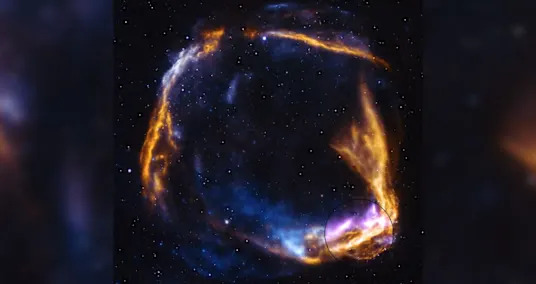
A NASA X-ray telescope has captured a breathtaking portrait of a supernova remnant, revealing unseen features of the exploded star.
What is it?
This image depicts the supernova remnant SN 185, found some 8,000 light-years away from Earth in the direction of the sun's closest sibling, the triple star Alpha Centauri. Based on historical records made by Chinese astronomers, scientists believe the star exploded in the year AD 185. It may have been visible in the sky for as many as eight months.
In this new image, NASA's Imaging X-ray Polarimetry Explorer (IXPE) observatory helped astronomers study the outer rim of this object (also known as RCW 86) and discover that the expansion of the remnant's gases appears to have stopped in the region NASA has highlighted by a purple ring in the image.
Astronomers have previously found that a large low-density "cavity" in the center of the supernova caused it to expand more rapidly than they would normally expect, and now IXPE's new observation of this outer rim helps "fill in a fuller picture of what other telescopes have observed," NASA wrote in a statement accompanying the image.
Why is it amazing?
IXPE captured the image using its unique ability to study the polarization of X-rays, or how waves of X-ray light oscillate relative to their direction.
By studying this polarization, IXPE can help astronomers probe some of the deepest mysteries of the cosmos, such as why black holes spin, what powers the extreme jets blasting from supermassive black holes, or why pulsars glow so brightly in X-ray light.
IXPE launched on Dec. 9, 2021, from NASA's Kennedy Space Center in Florida atop a SpaceX Falcon 9 rocket. In its first four years of operation, it has studied a black hole's "heartbeat", observed supernova remnants, and peered into the magnetic fields of neutron stars.
LATEST POSTS
- 1
 Islamabad: Iran allows 20 Pakistani ships through Strait of Hormuz
 - 2'Not the moon that I'm used to seeing': Artemis II astronauts describe seeing the far side
- 3Twins were the norm for our ancient primate ancestors − one baby at a time had evolutionary advantages
- 4Pick Your Favored kind of soup
- 5NASA releases new ‘Earthset’ and eclipse images taken during historic flyby of the moon



- Chicago reports first rabies-positive dog in 61 years. What we know.
- Don't miss these five impressive spots in Bangkok
- New science points to 4 distinct types of autism
- Ringleader of suspected human trafficking network arrested in Ethiopia
- Carina Nebula shines with white-blue stars | Space photo of the day for Jan. 5, 2026
- Defense Minister Katz moves to extend IDF service to 36 months
- From record warming to rusting rivers, 2025 Arctic Report Card shows a region transforming faster than expected
- The most effective method to Help a Friend or family member Determined to have Cellular breakdown in the lungs
- Jason Kelce opens about wife Kylie Kelce's past pregnancy loss